
Virtual Receptionist Pricing 2026: Costs, Models & Fees

TL;DR
Virtual receptionist pricing ranges from $25/month for basic AI tools to $1,900+/month for premium human answering services. Law firms typically pay $189 to $775/month depending on call volume and whether they choose AI, human, or hybrid reception. Per-minute billing models punish growing firms with unpredictable overages, while flat-rate and per-call models offer more budget certainty. This guide breaks down real costs across five providers, exposes hidden fees, and shows what three different firm sizes actually pay each month.
Why Virtual Receptionist Pricing Is So Confusing
Every provider’s pricing page tells a different story, and none of them tell the whole story. One quotes per-minute rates. Another quotes per-call rates. A third bundles minutes into tiers but charges 2x your base rate when you go over. Some tack on setup fees, bilingual surcharges, and transfer charges that inflate your bill 20 to 30 percent above the advertised price.
The confusion is expensive. Unanswered calls cost small and medium businesses an average of $126,000 per year, with each missed call representing roughly $1,200 in lost revenue. For law firms specifically, 35% of calls go completely unanswered, and 80% of callers who reach voicemail hang up without leaving a message. Choosing the wrong virtual receptionist (or overpaying for the right one) compounds that loss.
This guide covers five services with real dollar amounts, compares three pricing models, and runs the math on what firms of different sizes actually pay. No “contact us for pricing” dodges.
Explore Lawtté’s AI receptionist to see how legal-specific AI pricing compares.
At-a-Glance Comparison Table
| Provider | Type | Starting Price | Pricing Model | Best For | Legal-Specific? |
|---|---|---|---|---|---|
| Lawtté | AI | $189/mo | Per-minute bundle (75 calls included) | Law firms wanting full legal workflow integration | Yes |
| Smith.ai | Hybrid | $95/mo | Per-call | Low-volume firms testing AI reception | Partial |
| Ruby | Human | $245/mo | Per-minute | Family law and estate planning with light call volume | No |
| LEX Reception | Human | $425/mo | Per-minute | Mid-size legal practices needing 24/7 human coverage | Yes |
| Answering Legal | Human | $65/mo + $2.30/min | Per-minute | Criminal defense and PI firms needing bilingual staff | Yes |
How Virtual Receptionist Pricing Models Work
Before comparing providers, it helps to understand the three billing structures you will encounter. Each creates different incentives and risk profiles for your firm.
Per-Minute Pricing
Used by Ruby, LEX Reception, and Answering Legal. You buy a block of minutes each month and pay overage rates for anything beyond that block. The problem: per-minute models incentivize agents to extend calls. Practitioners on Reddit report that even simple tasks like spelling a client’s name can stretch to two minutes when an agent is billing by the minute. Firms with fluctuating call volume face unpredictable bills.
Minute rounding makes this worse. Providers that round up to the next full minute can inflate your bill by 30 to 40 percent compared to exact-second billing.
Per-Call Pricing
Smith.ai uses this model. You pay a flat fee per call regardless of duration. This is more predictable than per-minute billing but gets expensive fast when add-ons stack up. Transfers cost $3 each. Text or email follow-ups run $0.50 per call. Complex routing adds $1.50 per call.
Flat-Rate and Bundled Pricing
AI-first providers typically bundle a set number of calls or minutes into a monthly plan with a fixed overage rate. This model rewards efficiency since the AI handles calls quickly without billing incentives to extend conversations. For a deeper look at how AI receptionist costs break down for law firms, that guide covers the math in detail.
Virtual Receptionist Pricing by Provider
1. Lawtté
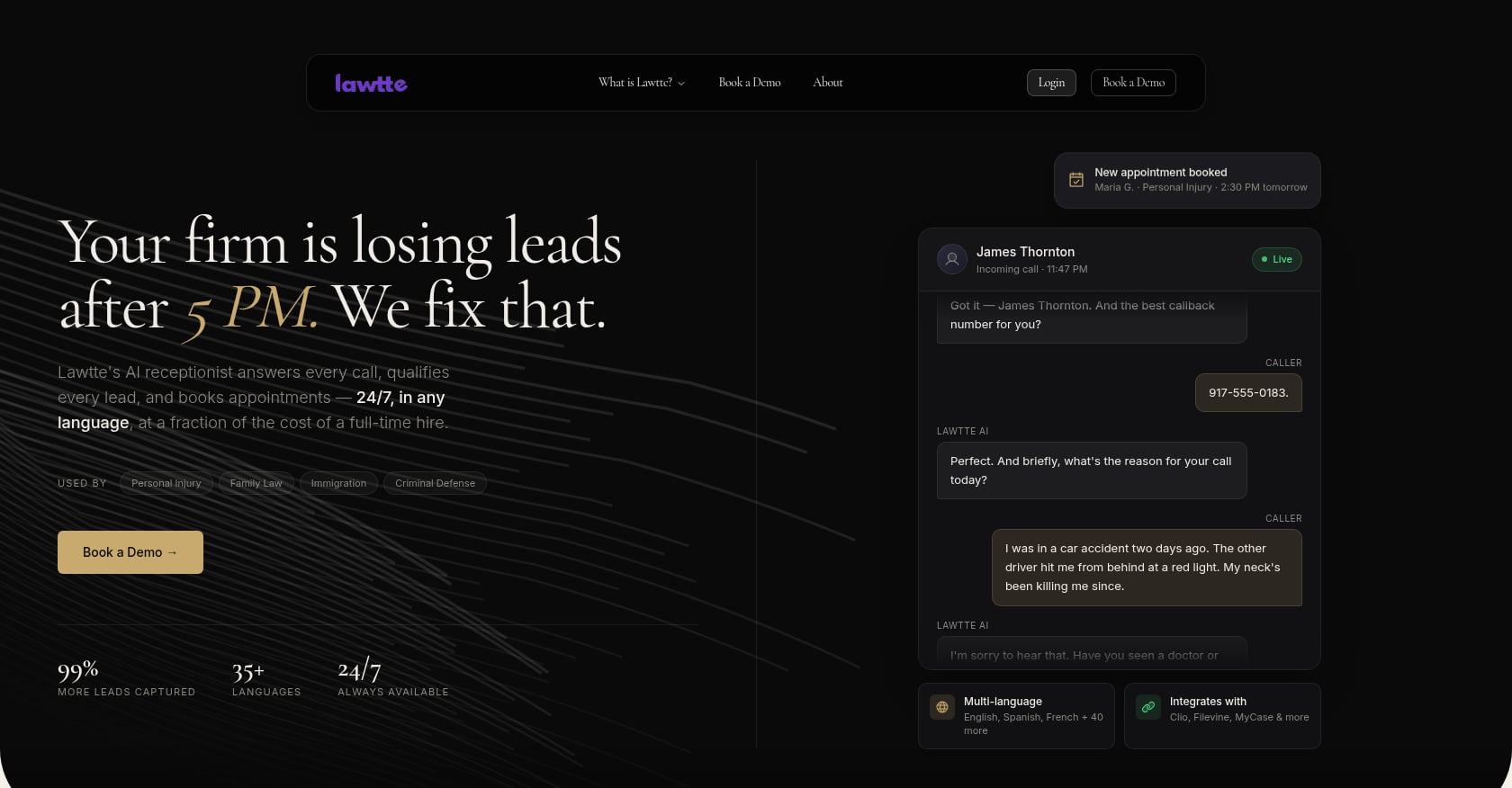
Best for: Law firms of any size wanting a legal-native AI receptionist with deep practice management integrations.
Pricing:
- Solo plan: $189/month, includes 75 calls (~225 minutes)
- Overage rate: $0.80/minute
- Bundle discounts: 10% off when pairing two products, 15% off all three (Concierge + Link + Scale)
- Annual billing saves 20%
What’s included:
- 24/7 AI reception on phone, chat, and SMS
- Support for 10+ languages with auto-detection during intake
- Spam filtering and smart routing without IVR trees
- End-to-end call encryption; data not used to train models
- Integrations with Clio, Filevine, MyCase, CasePeer, Lawmatics, PracticePanther, and Litify
Key differentiator: Lawtté is not a generic answering service configured for legal. It is a legal-specific AI suite that extends beyond reception into AI-powered intake, case management, and lead nurture. The integration depth across seven legal practice management systems is unmatched by any provider on this list.
Limitations:
- AI voice may need escalation for emotionally complex calls (though escalation routing is built in)
- No human fallback option within the platform itself
- Best suited for firms comfortable with AI-first client interaction
What practitioners say: According to Clio’s Legal Trends Report, 70% of clients prefer or are neutral toward firms using AI technology, which aligns with the broader trend. Legal firms have led AI adoption, with 79% using AI in 2024, up from 19% in 2023.
2. Smith.ai
Best for: Low-volume firms wanting to test AI reception at a low entry price.
Pricing:
- Starts at $95/month
- Per-call overage: $2.40/call over 50, $2.30/call over 150, $2.10/call over 500
- No setup fees, no contracts, no spam charges
What’s included:
- AI-powered call answering with option to escalate to human agents
- Basic intake and lead qualification
- CRM integrations (though legal PMS coverage is narrower than legal-specific tools)
Limitations:
- Add-ons inflate cost quickly: text/email follow-up at $0.50/call, complex routing at $1.50/call, transfers at $3/call
- Budget 20 to 30 percent above the base plan for realistic monthly costs
- Legal-specific workflow depth is limited compared to purpose-built legal platforms
What practitioners say: G2 shows 90% five-star reviews across 73 Virtual Receptionist reviews. But Trustpilot’s 334 reviews (averaging 4.4 stars) are where billing complaints concentrate. One G2 reviewer noted that “a small number of callers are put off when they realize an AI receptionist is handling their call,” though this was about caller perception rather than call quality.
3. Ruby Receptionists
Best for: Firms with fewer than 50 calls/month wanting premium human empathy, particularly family law and estate planning.
Pricing:
- 50 minutes: $245/month
- 200 minutes: $720/month
- 500 minutes: $1,725/month
- No rollover on unused minutes
What’s included:
- 24/7 live answering including after-hours, weekends, and holidays
- Bilingual (English/Spanish) call handling at no extra charge
- No setup, onboarding, or customization fees
Limitations:
- No rollover minutes. Pay for 200, use 150, and you lose those 50 minutes.
- Overage rates are steep (implied $3.45 to $4.90 per minute depending on plan)
- Not legal-specific. Ruby serves all industries, so receptionists lack practice-area training.
- Costs become prohibitive at scale. One Reddit user reported paying about $700/month for 500 inbound calls.
What practitioners say: Capterra reviews show competitors calling Ruby “unbelievably overpriced.” But legal users counter that “Ruby receptionists are accurate, prompt, and represent law firms very well.” The consensus: Ruby delivers quality but the virtual receptionist pricing works best for very low-volume firms. Firms interested in estate planning reception specifically may want to compare AI alternatives for estate planning.
4. LEX Reception
Best for: Mid-size legal practices wanting 24/7 human reception with legal-specific training.
Pricing:
- Entry plan: $425/month for 150 minutes, plus $75 one-time setup fee
- Best Value plan: $450/month for 300 minutes
- Growth plan: $775/month for 500 minutes
- Overages: $2.25 to $2.75/minute, billed in one-minute increments
What’s included:
- Legal-trained human receptionists
- Integrations with Clio, MyCase, and PracticePanther
- 24/7 live answering
Limitations:
- Minute rounding inflates bills since every call rounds up to the next minute
- Pronunciation accuracy can be challenging, according to Capterra users
- Full pricing is not published on their website
- Setup fee adds friction that most AI competitors have eliminated
What practitioners say: One Capterra user noted LEX could “provide comparable service for about 25% less” than their previous provider. The legal focus is a genuine advantage over generalist services like Ruby.
5. Answering Legal
Best for: Criminal defense and PI firms needing true 24/7 live answering with legal-only, U.S.-based bilingual receptionists.
Pricing:
- Starts at $65/month plus $2.30/minute
- Solo Plan: 100 minutes at $3.60/minute
- Higher tiers reduce per-minute rates
- Plans range up to approximately $1,900/month based on volume
What’s included:
- 100% U.S.-based bilingual receptionist staff (no offshoring)
- Legal-specific call handling
- 24/7 availability
Limitations:
- Per-minute pricing with no published tier structure makes budgeting difficult
- The low base price is deceptive because minute charges add up fast
- Limited technology integrations compared to AI-first platforms
- No AI component for after-hours efficiency
For criminal defense firms evaluating reception options, this guide to AI intake for criminal defense covers the specific workflow considerations.
The Real Cost: 3 Law Firm Scenarios
Virtual receptionist pricing only makes sense in context. Here is what three different firm profiles actually pay each month across providers, assuming an average call length of 3 minutes.
Scenario 1: Solo PI Attorney, 50 Calls/Month (150 Minutes)
| Provider | Monthly Cost | Notes |
|---|---|---|
| Lawtté | $189 | 75 calls included, well within plan |
| Smith.ai (AI) | $95 | Base plan covers 50 calls |
| Ruby | $245 | 50-min plan insufficient; 200-min plan at $720 needed |
| LEX Reception | $425 | Entry plan, using 150 of 150 minutes |
| Answering Legal | $65 + $345 = $410 | Base + 150 min × $2.30 |
Ruby’s 50-minute plan covers barely 16 calls at 3 minutes each, forcing the solo attorney into the $720 tier. Lawtté and Smith.ai’s AI tier are the clear value plays here.
Scenario 2: Small Family Law Firm, 150 Calls/Month (450 Minutes)
| Provider | Monthly Cost | Notes |
|---|---|---|
| Lawtté | $189 + $60 overage = $249 | 75 calls included; 75 extra calls × ~$2.40 in minutes at $0.80/min |
| Smith.ai (AI) | $95 + $240 = $335 | 50 calls base + 100 × $2.40 overage |
| Smith.ai (Human) | ~$1,200+ | 150 calls with add-ons |
| Ruby | $720 + $1,225 = $1,945 | 200-min plan; 250 overage minutes at ~$4.90 |
| LEX Reception | $450 + $337.50 = $787.50 | 300-min plan; 150 overage min at $2.25 |
| Answering Legal | $65 + $1,035 = $1,100 | Base + 450 min × $2.30 |
This is where per-minute virtual receptionist pricing punishes growth. Ruby’s actual cost at 150 calls is nearly 8x Lawtté’s. Even LEX, the most competitively priced human option, costs over 3x as much. Family law firms specifically can explore how AI reception handles sensitive intake.
Scenario 3: Growing Multi-Practice Firm, 300 Calls/Month (900 Minutes)
| Provider | Monthly Cost | Notes |
|---|---|---|
| Lawtté | $189 + $300 = $489 | 75 calls included; 225 extra calls in overage minutes |
| Smith.ai (AI) | $95 + $600 = $695 | 50 base + 250 × $2.40 |
| Smith.ai (Human) | $1,900+ | At 180 calls the plan hits ~$1,900; 300 calls pushes well beyond |
| Ruby | $1,725 + $1,960 = $3,685 | 500-min plan; 400 overage min at ~$4.90 |
| LEX Reception | $775 + $900 = $1,675 | 500-min plan; 400 overage min at $2.25 |
| Answering Legal | $65 + $2,070 = $2,135 | Base + 900 min × $2.30 |
At 300 calls a month, human services cost between $1,675 and $3,685. AI solutions stay under $700. The gap widens with every additional call, which is what makes per-minute billing a growth tax: your costs rise in direct proportion to your success.
Hidden Fees and Overage Traps
This is the section most pricing guides skip. Before signing any contract, check for these:
1. Overage penalties. Exceeding your monthly plan typically costs $1.50 to $4.90 per extra minute, roughly 1.5 to 2x your base rate. On Ruby’s 200-minute plan, 250 minutes of overage can add $1,225 to a single month’s bill.
2. Setup and onboarding fees. Many live services charge $75 to $500 for initial setup and training. Some enterprise providers charge $1,000+. Most AI services have eliminated setup fees entirely.
3. Per-call add-ons. Smith.ai charges $3 per transfer to a live agent, $0.50 per text/email follow-up, and $1.50 for complex call routing. These stack fast.
4. Bilingual surcharges. Some services charge 20 to 30 percent more for bilingual operators or require a separate Spanish-language plan. Ruby includes bilingual handling at no extra cost. Lawtté supports 10+ languages with auto-detection. For immigration firms where multilingual support is essential, this guide to multilingual AI reception covers the details.
5. Minute rounding. Full-minute rounding means a 2-minute-and-10-second call bills as 3 minutes. Over hundreds of calls, that inflates your bill by 30 to 40 percent. Always ask how your provider counts minutes.
6. No rollover. Ruby and most human services don’t roll unused minutes forward. You lose what you don’t use.
7. After-hours and holiday premiums. Verify whether your provider charges extra for holidays or after-hours calls. Analysis of 347,609 calls across 2,074 businesses found that 28.5% of calls arrive outside business hours, and 34.8% of those callers express buying intent. You cannot afford to either miss those calls or pay a premium surcharge for every one.
AI vs. Human Reception: When Each Makes Sense
The choice is not purely about virtual receptionist pricing. It is about which caller interactions demand human judgment and which benefit from AI’s speed and consistency.
Where AI wins decisively
After-hours and weekend calls. An AI receptionist handles concurrent calls without overtime, holiday pay, or staffing gaps. For personal injury firms running advertising campaigns, call spikes at 10 PM are common. An AI handles high-volume PI intake without queuing callers or going over budget.
Multilingual intake. AI with language auto-detection eliminates the need for separate bilingual plans or surcharges.
Consistency and speed. Studies show that contacting a new lead within 5 minutes makes them up to 100 times more likely to convert compared to waiting 30 minutes. AI responds instantly. Human services depend on agent availability.
High-volume months. When marketing campaigns drive call spikes, AI pricing stays predictable. Human per-minute costs spike proportionally.
Where human reception still matters
Grief-adjacent practice areas. Estate planning clients calling after a death, family law clients in crisis, and similar situations sometimes need a human voice. One G2 reviewer noted that some callers are “simply not comfortable with the technology itself,” regardless of how well the AI performs.
Complex scheduling and triage. Cases requiring real-time judgment calls about urgency, like criminal defense clients calling from jail, may benefit from experienced human receptionists who can read emotional context.
The hybrid approach. Many firms are landing on AI for the first touch and after-hours coverage, with human escalation paths for sensitive situations. This captures 80 to 90 percent of the cost savings while preserving empathy where it counts.
One practitioner on Reddit summed it up well: “I’ve been using an AI-powered receptionist to handle after-hours calls and follow-ups. It’s been super helpful, 70% cheaper than Ruby or Smith.”
The In-House Alternative: What It Really Costs
Comparing virtual receptionist pricing against hiring requires honest math. A full-time receptionist is not a $36,920/year line item (the median salary per the Bureau of Labor Statistics). Once you add benefits, payroll taxes, training, PTO, and turnover costs, the fully loaded number lands at $51,450 to $69,700 per year, or $4,288 to $5,808 per month.
That employee works 40 hours a week. They take lunch breaks, sick days, and vacations. They handle one call at a time. They don’t speak 10 languages. And according to data on attorney productivity, the average lawyer captures just 3.0 billable hours in an eight-hour workday, with every interruption requiring 25 minutes to fully regain concentration.
An in-house receptionist makes sense for firms with very high call volume (500+ calls/month), complex scheduling needs, and a physical office that benefits from a front desk presence. For everyone else, the economics overwhelmingly favor virtual options.
How to Choose the Right Virtual Receptionist
Run through these questions in order:
1. What is your monthly call volume? Under 50 calls, almost any option works. At 100+, per-minute human services become expensive fast. At 300+, only flat-rate AI or in-house hiring makes financial sense.
2. What is your monthly budget? Be honest about what you can sustain, not just what the base plan advertises. Add 20 to 30 percent for overages and add-ons on human services.
3. Which practice management system do you use? Integration depth varies wildly. If your firm runs on Clio, Filevine, MyCase, or CasePeer, check that your receptionist service connects natively rather than requiring manual data entry.
4. Do you need multilingual support? If yes, verify whether it costs extra. Bilingual surcharges of 20 to 30 percent are common on human services.
5. Is 24/7 coverage essential? For PI, criminal defense, and immigration firms, the answer is almost always yes. After-hours calls represent real revenue.
6. Does your practice area require human empathy on first contact? If so, consider a hybrid model or a human service for specific call types, with AI handling overflow and after-hours.
For firms ready to evaluate a legal-specific AI approach, book a demo with Lawtté to see how the pricing works with your actual call volume.
Frequently Asked Questions
How much does a virtual receptionist cost per month for a law firm?
Virtual receptionist pricing for law firms ranges from $95/month for basic AI services to $1,900+/month for premium human reception at high volumes. Most small firms spend between $189 and $775 per month. The actual cost depends on your call volume, chosen pricing model (per-minute, per-call, or flat-rate), and any add-ons your firm requires.
Is an AI virtual receptionist as good as a human one?
For most call types, yes. AI receptionists handle intake screening, appointment scheduling, and after-hours calls with greater consistency and speed than human agents. They also handle multiple concurrent calls without hold times. The gap narrows every year, and 70% of legal clients are now comfortable with or neutral toward AI, according to Clio’s Legal Trends Report. Human reception still holds an edge for emotionally sensitive conversations.
What hidden fees should I watch for with virtual receptionist services?
The most common hidden costs are overage penalties ($1.50 to $4.90 per extra minute), setup fees ($75 to $500+), per-call add-ons for transfers and follow-ups, bilingual surcharges (20 to 30 percent), and full-minute rounding that inflates call durations. Always ask for a total cost estimate based on your actual call volume rather than relying on base plan prices.
How do I calculate the ROI of a virtual receptionist?
Start with your missed call rate. If 85% of unanswered callers never call back, and each represents $1,200 in potential revenue, even capturing 10 additional calls per month adds $12,000 in potential revenue. Compare that against your virtual receptionist cost. For most firms, the service pays for itself within the first month.
Can a virtual receptionist integrate with my legal practice management software?
Integration depth varies significantly. Some providers only integrate with one or two systems. Others, like Lawtté, connect natively with Clio, Filevine, MyCase, CasePeer, Lawmatics, PracticePanther, and Litify. Always verify integration compatibility before signing a contract since manual data entry defeats much of the efficiency gain.
Is per-minute or per-call pricing better for law firms?
Per-call pricing is generally more predictable because call duration does not affect your bill. Per-minute pricing can be cheaper for firms with very short average call times but becomes expensive and unpredictable as volume grows. Flat-rate bundled pricing, common among AI providers, offers the most budget certainty for growing firms.
What is the best virtual receptionist for personal injury law firms?
PI firms need high-volume call handling, fast lead response (within 5 minutes for optimal conversion), 24/7 coverage for ad-driven call spikes, and strong practice management integration. AI-first solutions typically fit best because PI call patterns are high-volume and time-sensitive. Per-minute human services become prohibitively expensive at the call volumes most PI advertising generates.
How does virtual receptionist pricing compare to hiring an in-house receptionist?
A full-time in-house receptionist costs $4,288 to $5,808 per month when you include benefits, payroll taxes, training, and turnover. That covers one person handling one call at a time during business hours. Virtual receptionist services (especially AI) provide 24/7 coverage with concurrent call handling for a fraction of that cost. In-house hiring only makes economic sense at very high volumes with complex on-site needs.
Bring Lawtté to your firm.
Walk us through your intake and case workflow — we'll have your AI live in 14 days.
Book a Demo →

 30 minutes
 Built around your practice
 No generic slide deck