
Multilingual AI Receptionist: 8 Best for Law Firms (2026)

TL;DR
Nearly 68 million Americans speak a language other than English at home, and 35% of law firm calls go unanswered. For immigration, personal injury, and family law practices in diverse markets, a multilingual AI receptionist isn’t optional. This guide compares eight platforms on language count, pricing, legal specialization, and CRM integration. Lawtté tops the list for firms wanting an all-in-one legal AI suite with broad language support, while budget options like Upfirst work for solos just getting started.
Why Multilingual Intake Is Revenue Infrastructure, Not a Nice-to-Have
The U.S. Census Bureau reports that 67.8 million Americans speak a language other than English at home. In Texas, 30% of the population speaks Spanish at home. In California, it’s 29%. And those numbers don’t account for the growing Mandarin, Vietnamese, Haitian Creole, Arabic, and Korean-speaking communities concentrated in major metro areas where law firms compete hardest for clients.
Here’s the math that should worry any firm owner: 35% of calls to law firms go completely unanswered, and roughly 67% of legal clients hire the first attorney who actually answers the phone. When a Spanish-speaking caller dials your office at 7 PM and gets an English-only voicemail, they don’t wait. They call the next firm on Google. That’s not a missed call. That’s a missed retainer.
The legal profession loses an estimated $98 billion annually in missed client opportunities. A multilingual AI receptionist closes that gap by answering every call, in the caller’s language, at any hour.
Explore Lawtté’s AI receptionist to see how 24/7 multilingual intake works in practice.
At-a-Glance Comparison Table
| Tool | Languages | Starting Price | Billing Model | Legal-Specialized | Native Legal CRM | Language Detection |
|---|---|---|---|---|---|---|
| Lawtté | 10+ | $189/mo | Per-call + overage | Yes | Clio, Filevine, MyCase, CasePeer + more | Auto-detect |
| Smith.ai | 2 (EN/ES) | $95/mo (AI) | Per-call + add-ons | Partial | Clio, Lawmatics via integration | Manual add-on |
| Ruby | 2 (EN/ES) | $235/mo | Per-minute | No | Clio via integration | Human routing |
| CloudTalk | 60+ | $0/mo (AI Receptionist) | Per-user + per-minute | No | Zapier-dependent | Auto-detect |
| LEX Reception | 2 (EN/ES) | $425/mo | Per-minute | Yes | Clio, MyCase | Human routing |
| CaseGen AI | 17+ | Flat-rate (varies) | Flat-rate | Yes | Expanding | Auto-detect |
| ClaireAI | 2 (EN/ES) | $650/mo | Flat-rate | Yes | Varies | Auto-detect (1-2 sec) |
| Upfirst | 35+ | $24.95/mo | Per-call | No | Zapier + Clio | Auto-detect |
How Multilingual AI Reception Actually Works
Before comparing tools, it helps to understand what happens when a non-English speaker calls a firm using a multilingual AI receptionist.
Automatic language detection. The AI identifies the caller’s language within the first one to three seconds of speech. There’s no phone tree asking callers to “press 2 for Spanish.” The system simply recognizes the language and responds in kind. This matters because IVR menus create friction, and friction kills conversions. Speed-to-lead research shows that a 60-second response yields 391% higher conversion compared to slower engagement.
Legal terminology in the caller’s language. A generic translation won’t cut it for legal intake. The AI needs to understand and use terms like “orden de protección” (protection order), “demanda por lesiones” (injury claim), or “petición de asilo” (asylum petition). The best multilingual AI receptionists are trained on legal vocabulary, not just conversational language.
Translated CRM notes. This is a workflow advantage that gets overlooked. When intake happens in Spanish but the CRM notes sync in English, attorneys review case details without a manual translation step. The caller gets comfort in their language; the lawyer gets clarity in theirs.
Concurrent multilingual calls. A human bilingual receptionist can handle one call at a time. An AI receptionist can handle dozens of calls simultaneously, each in a different language. During a marketing campaign spike, that concurrency is the difference between capturing leads and sending them to voicemail. And 80% of callers won’t leave a voicemail if their call goes unanswered.
For a deeper look at how intake workflows connect to your practice management system, see this guide on legal client intake best practices.
The 8 Best Multilingual AI Receptionists for Law Firms
1. Lawtté
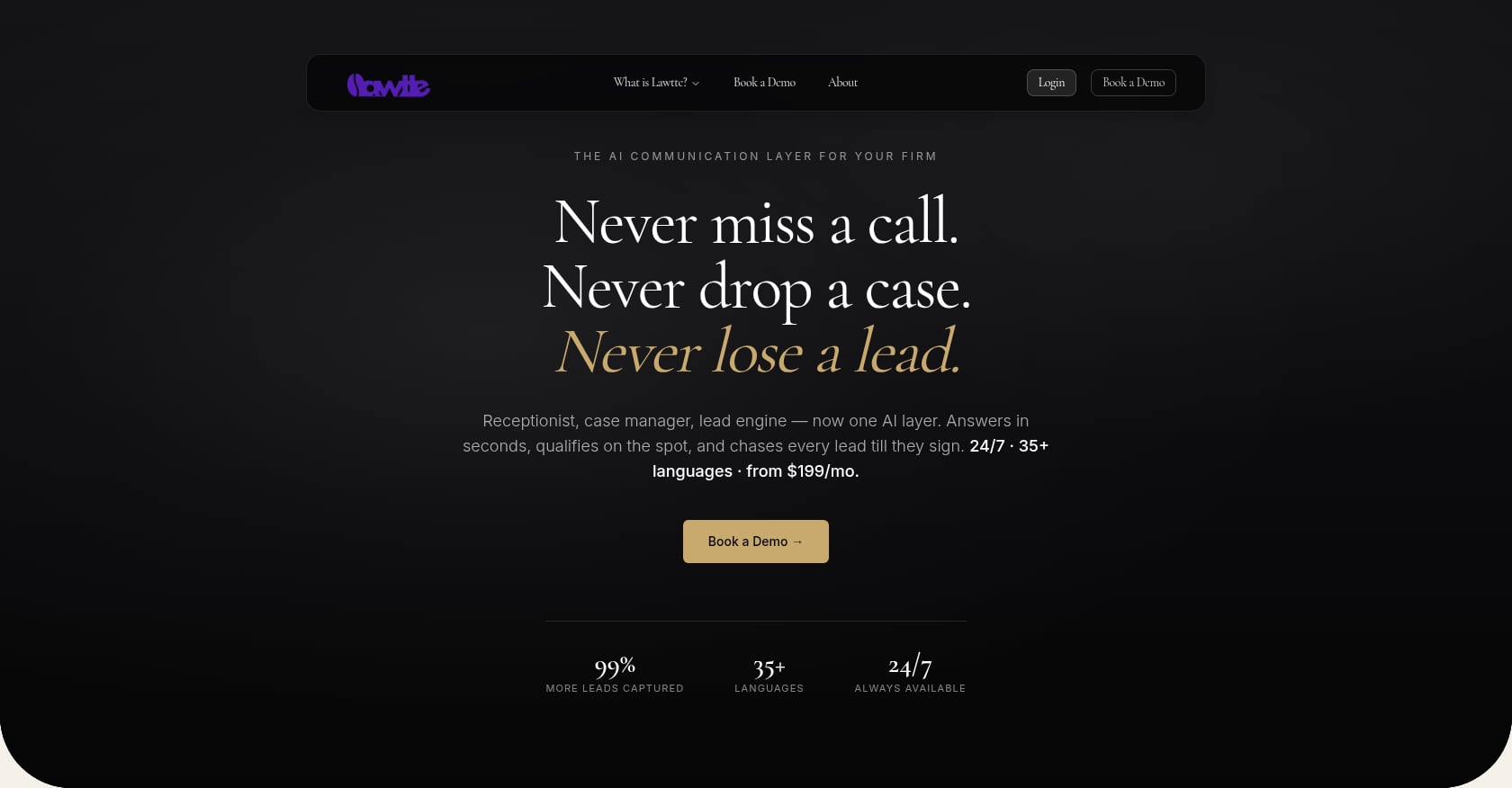
Best for: Law firms wanting an all-in-one AI platform spanning reception, case management, and outbound lead nurture with multilingual support and deep legal PMS integrations.
Languages: 10+ languages with auto-detection during intake.
Pricing: Concierge (AI Receptionist) starts at $189/month for Solo (75 calls/month, approximately 225 minutes). Overages run $0.80/minute. Bundle two products for 10% off or all three for 15% off. Annual billing saves 20%.
Key features:
- 24/7 AI reception on phone, chat, and SMS with no IVR trees
- Handles up to 100 concurrent calls, so marketing spikes don’t mean missed leads
- Practice-area tuning for PI, family, immigration, criminal defense, estate planning, and more
- Native integrations with Clio, Filevine, MyCase, CasePeer, Lawmatics, PracticePanther, and Litify
- End-to-end call encryption; data not used to train models (per TOS)
- Scale product adds TCPA-compliant outbound dialing at 100+ calls/hour for PI-specific chases
- 37 REST API endpoints for custom automation
- Spam call filtering and smart routing
What makes it different: Lawtté is the only platform on this list offering AI reception plus AI case management plus outbound lead management as an integrated suite. Most competitors sell a receptionist. Lawtté sells a front-to-back intake and case movement engine.
An Artificial Lawyer walkthrough (January 2025) featured live demos showing natural responses and language switching during intake calls. On-site testimonials cite a 45% increase in qualified leads and a 38% conversion lift.
Tradeoffs:
- Language count descriptions vary across pages (verify configured languages during onboarding)
- AI voice may need escalation for edge cases, though escalation routing is built in
- No public SOC 2 attestation listed; security posture is marketed but formal certifications aren’t shown
- Newer brand compared to 20-year-old competitors like Ruby
Practitioner perspective: Lawyers on Reddit’s r/LawFirm have been increasingly vocal about AI receptionists, with one practitioner noting their AI-powered solution is “70% cheaper than Ruby or Smith” while handling after-hours calls and follow-ups effectively.
Book a personalized demo to see multilingual intake in action with your practice area’s terminology.
2. Smith.ai
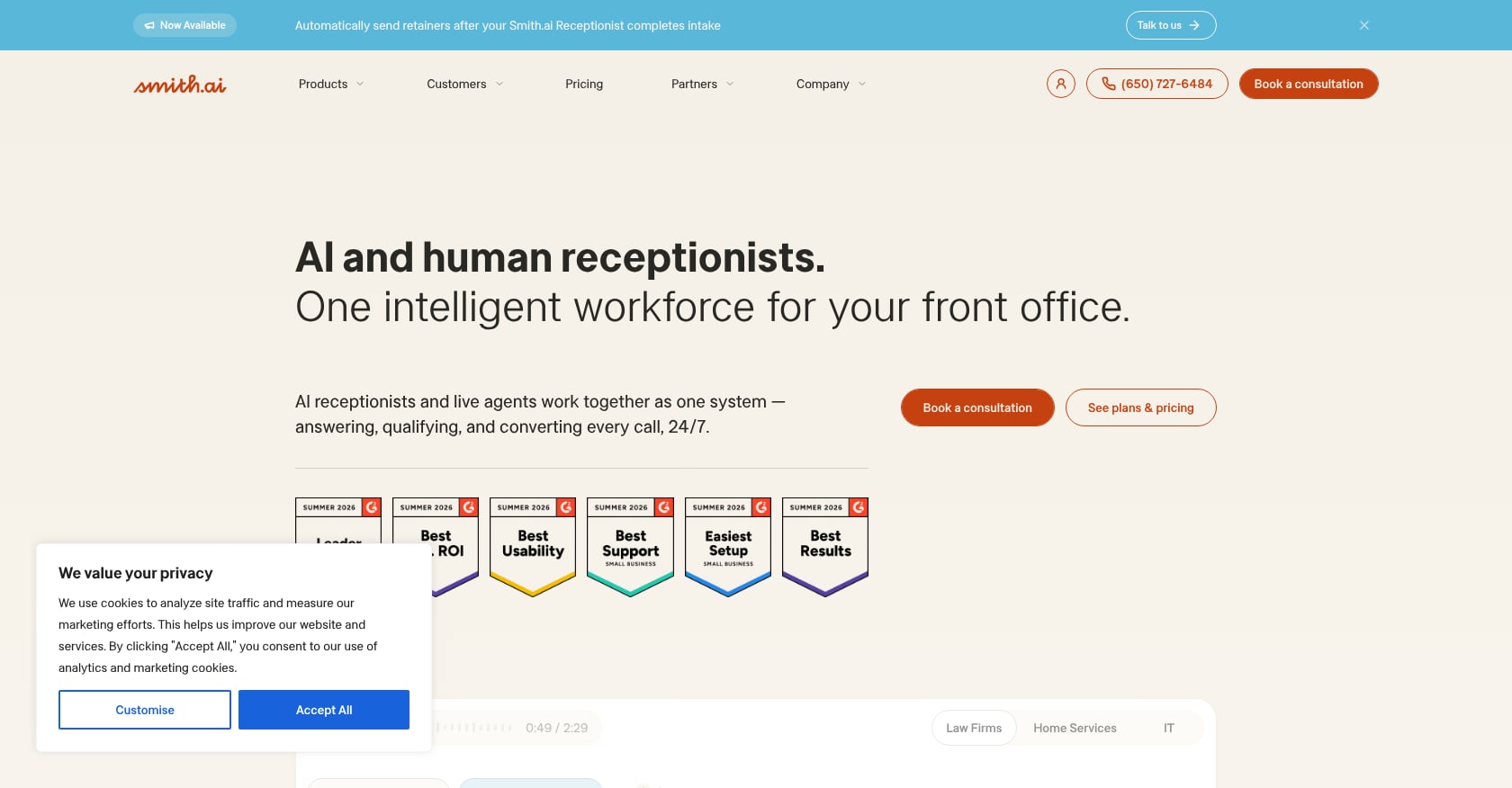
Best for: Small law firms handling 30 to 150 calls per month that want a human safety net on sensitive calls and are fine with English and Spanish only.
Languages: 2 (English and Spanish). Spanish handling adds $1.00 per call on top of base pricing.
Pricing: AI Receptionist starts at $95/month (approximately 60 calls included) with per-call rates of $1.60 to $1.90 within tier and $2.40 overage. The hybrid Virtual Receptionist starts at $292.50/month for 30 calls. Enabling booking, SMS, recording, and Spanish on every call adds $3.25 per call on top of the base rate.
Key features:
- Hybrid AI + human model with live agent escalation
- Founded in 2015, handled over 10 million calls across 5,000+ businesses
- Integrations with Clio, Lawmatics, and other legal tools
- Call recording, SMS follow-up, and booking capabilities
Tradeoffs:
- Only two languages, and the Spanish surcharge punishes bilingual usage at volume
- A business making 200 Spanish calls per month pays an extra $200 just for the language add-on
- Multiple reviewers on G2 and Trustpilot report the AI escalating calls to live agents without authorization, triggering a $3.00 per-transfer charge
- Not designed for firms needing Mandarin, Haitian Creole, Arabic, or other languages common in immigration practice
User sentiment: Smith.ai holds 4.3/5 on Trustpilot across 336+ reviews. The per-call Spanish add-on is widely criticized in independent reviews as a hidden cost that escalates quickly.
For firms comparing pricing models in detail, this breakdown of virtual receptionist pricing and hidden fees is worth reviewing.
3. Ruby Receptionists
Best for: Firms that prioritize human warmth on every call and primarily serve English-speaking clients.
Languages: 2 (English and Spanish). Bilingual agents are available Monday through Friday, 6:00 AM to 5:00 PM Pacific Time only.
Pricing: Starts at $235/month for 50 minutes. Per-minute costs range from $3.39 to $4.90 depending on plan. Overage rates: $5.40/minute on the 50-minute plan, $4.45/minute on the 100-minute plan.
Key features:
- 100% human receptionists with 120 hours of training
- 20+ year track record with 15,000+ small business clients
- Professional, empathetic call handling
Tradeoffs:
- Spanish availability is limited to weekday business hours on the West Coast, a significant gap for firms serving Hispanic communities who call evenings and weekends
- Per-minute billing creates unpredictable monthly costs, especially during campaign spikes
- No languages beyond English and Spanish
- No AI component means no concurrent call handling
User sentiment: One Capterra reviewer noted, “I needed speakers of additional languages to communicate with my immigration clients,” indicating Ruby fell short. Practitioners on Reddit report spending around $700/month for 500 inbound calls, with costs climbing quickly on higher-minute plans.
4. CloudTalk
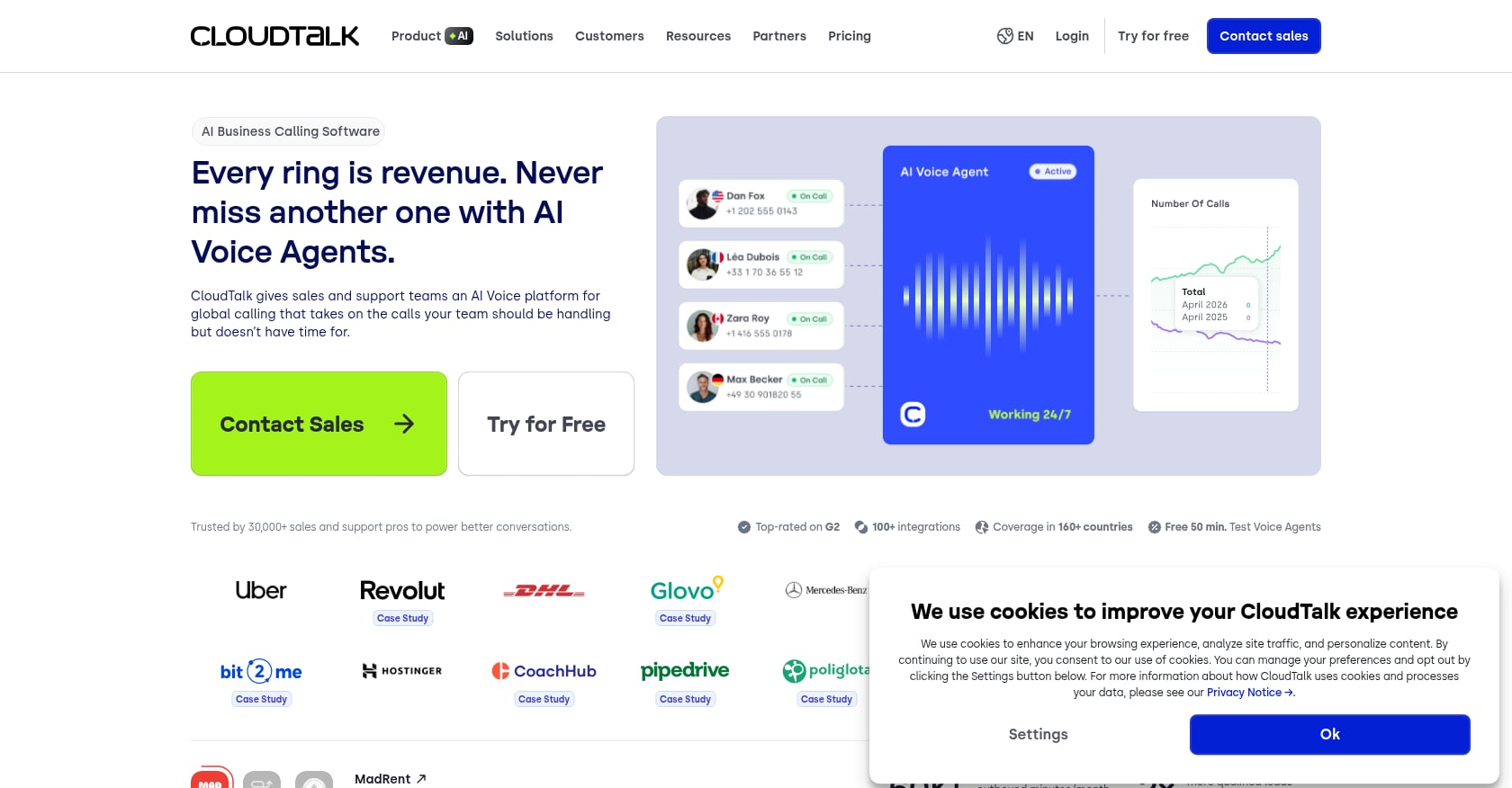
Best for: Multi-location firms with high call volumes needing the broadest possible language coverage and a full VoIP phone system.
Languages: 60+ languages and accents with instant auto-detection. The strongest raw language count on this list.
Pricing: Phone system plans start at $19/user/month. AI Receptionist: from $0/month (50 minutes included). AI Specialist: from $349/month (1,000 minutes included). AI Voice Agent runs approximately $0.25 per minute.
Key features:
- AI detects and speaks 60+ languages instantly
- Full VoIP and call center platform with routing, IVR, and analytics
- 4.4/5 on G2 across 1,624 reviews
- Broad business integrations (Salesforce, HubSpot, Zendesk)
Tradeoffs:
- Not legal-specialized. No practice-area tuning, no legal intake workflows, no legal terminology training
- CRM integrations to legal tools like Clio go through Zapier, not natively
- A single-location firm pays for dialer and call center capabilities it will never use
- The receptionist function is a feature inside a larger platform, not the core product
User sentiment: CloudTalk is well-reviewed as a general call center solution, but G2 reviewers note the learning curve and feature bloat for smaller teams.
5. LEX Reception
Best for: Firms wanting a legal-only human service with established Clio and MyCase integrations at an enterprise scale.
Languages: 2 (English and Spanish).
Pricing: Entry plan is $425/month for 150 minutes plus a $75 one-time setup fee. Overages run $2.75/minute. For a firm receiving 200 calls averaging 3 minutes each, real monthly cost typically lands between $1,100 and $1,400.
Key features:
- Exclusively serves law firms
- Integrations with Clio and MyCase
- 4.9/5 on Trustpilot
- Trained on legal intake terminology
Tradeoffs:
- No languages beyond English and Spanish. Misses French, Portuguese, Mandarin, Hindi, and other languages common in immigration and personal injury intake
- No AI component, so no concurrent call handling
- No detailed public pricing table; per-minute rounded-up billing makes long calls expensive
- Costs escalate fast for firms with above-average call volumes
6. CaseGen AI
Best for: PI and criminal defense firms wanting a legal-native AI receptionist at a flat monthly rate with expanding multilingual support.
Languages: 17+ languages including Spanish and Russian, with bilingual and multilingual support.
Pricing: Flat-rate model (exact pricing varies). Positioned against Smith.ai’s per-call structure, eliminating the budget risk that per-minute services create during marketing campaign spikes.
Key features:
- Built exclusively for law firms with a named AI agent (“Justina”)
- Handles multiple concurrent calls during busy periods
- Flat-rate pricing for predictable budgeting
- Designed for high-volume consumer law practices
Tradeoffs:
- Newer entrant with less review coverage than established competitors
- Integration ecosystem is still expanding
- 17 languages is solid but falls short of CloudTalk’s 60+ for firms with very diverse client bases
- Limited independent third-party reviews available
For criminal defense firms specifically, this guide on AI intake for criminal defense attorneys covers the unique requirements of that practice area.
7. ClaireAI
Best for: Firms in high-Hispanic-population areas wanting native-quality Spanish intake built by bilingual legal professionals.
Languages: 2 (English and Spanish), with Spanish intake flows built natively rather than translated.
Pricing: $650/month for 24/7/365 coverage.
Key features:
- Detects the caller’s language within 1 to 2 seconds and switches the entire intake flow
- Spanish flows built by bilingual legal professionals, ensuring cultural and legal accuracy
- Flat-rate pricing with full 24/7 coverage included
- Legal-specific intake design
Tradeoffs:
- Primarily bilingual, not broadly multilingual. Firms needing Mandarin, Haitian Creole, Arabic, or other languages will need a different solution
- $650/month is premium for a two-language offering
- Smaller company with limited independent reviews
- Feature set is narrower than platforms offering case management or outbound capabilities
8. Upfirst
Best for: Solo practitioners on tight budgets wanting broad language coverage at the lowest entry price.
Languages: 35+ languages with auto-detection.
Pricing: Starts at $24.95/month for 30 calls. Pro plan is $159.95/month for 300 calls.
Key features:
- Broad language support at a fraction of competitor pricing
- Sends call summaries by text and email
- Connects with Zapier, Google Calendar, and Clio
- Simple setup for small operations
Tradeoffs:
- Not legal-specialized. Goes lighter on payments, deep CRM integration, and industry-specific workflows than a full front office solution
- No practice-area tuning or legal terminology training
- Limited intake customization compared to legal-native platforms
- Zapier dependency for most integrations means added cost and potential reliability issues
The Market Has Split Into Three Tiers
Understanding where each tool falls helps clarify the buying decision:
Pure AI (broadest language coverage, lowest cost). Platforms like Lawtté, CloudTalk, CaseGen, and Upfirst use AI to handle calls. This approach naturally supports more languages because adding a language is a software configuration, not a hiring decision. Pure AI platforms handle concurrent calls without staffing constraints and operate 24/7 without overtime costs.
Hybrid AI + Human (mid-price, limited languages). Smith.ai is the prime example. AI handles initial routing, with human agents available for escalation. The model works well for English-dominant firms but struggles with multilingual needs because human agents only speak certain languages, and those capabilities come at a per-call premium.
Human-only (premium, English/Spanish ceiling). Ruby and LEX Reception stake their reputation on the human touch. The tradeoff is clear: higher cost, limited concurrency (one agent handles one call), and language support capped at two. Ruby’s bilingual agents aren’t even available 24/7.
For firms where multilingual capability is a core requirement, this market structure pushes the decision toward pure AI almost by default.
Choosing the Right Tool by Practice Area
A multilingual AI receptionist isn’t one-size-fits-all. The right choice depends on which languages your clients actually speak and how your practice area shapes call patterns.
Immigration law. You need the broadest language support possible. In New York, that means Mandarin, Haitian Creole, Russian, and Arabic alongside Spanish. In South Florida, add Portuguese and Haitian Creole. Auto-detection is mandatory because callers shouldn’t navigate an IVR menu in a language they don’t speak. Translated CRM notes matter enormously since the attorney reviewing the file may not speak the intake language. For immigration-specific guidance, this deep dive on multilingual AI for immigration law covers the unique requirements.
Personal injury in Texas, California, and Florida. Spanish is the non-negotiable minimum. High call volumes during TV and digital ad campaigns mean flat-rate or per-call pricing beats per-minute billing. A PI firm running a campaign that generates 300 calls in a week cannot afford $5.40/minute overages. Concurrency matters too, since multiple calls will come in simultaneously during peak ad hours. Firms focused on PI intake should also review how to qualify leads automatically for personal injury cases.
Family law. Callers are often emotional and dealing with sensitive situations like custody disputes, domestic violence, or divorce. Language comfort matters enormously in these conversations. A caller discussing abuse in their second language may not be able to articulate critical details. Spanish is essential in most markets, with additional community languages varying by geography.
Corporate and IP law. Call volumes are lower but per-call value is higher. You may need Mandarin, Japanese, German, or Korean for international clients. The priority shifts from call volume handling to accuracy and professionalism in specialized business terminology.
See how Lawtté serves California law firms or Texas law firms with tailored multilingual solutions.
What to Ask During a Demo
Most comparison articles skip this entirely. Before signing with any multilingual AI receptionist provider, run through these questions:
-
How many languages are configured by default versus available on request? Some platforms advertise 35+ languages but ship with only English and Spanish active. The rest may require setup time or additional configuration.
-
Is language detection automatic, or does the caller choose from a menu? Auto-detection removes friction. IVR language menus add it. This distinction directly affects conversion rates.
-
How does the AI handle legal terminology in non-English languages? Ask for a live demo in your most common non-English language. Test whether it knows practice-area terms, not just conversational phrases.
-
Do CRM and PMS notes appear in English, the caller’s language, or both? The ideal answer is “both” or “English with the option to view the original language.” If notes only sync in the caller’s language, you’ve created a translation bottleneck.
-
What happens when the AI can’t understand a caller? Every AI has limits. You want to know: does it escalate to a human? Transfer to a specific number? Take a message? The escalation protocol matters as much as the detection accuracy.
-
Are there extra charges for non-English calls? Smith.ai’s $1.00 per-call Spanish surcharge is the cautionary tale here. Get pricing clarity in writing before you sign.
-
Can the system handle concurrent calls in different languages simultaneously? If your firm runs ads in English and Spanish at the same time, you need confirmation that the AI doesn’t queue one language behind the other.
Bilingual Versus Multilingual: The Distinction That Matters
Most AI receptionist platforms advertise “bilingual support,” which almost always means English and Spanish. For firms in major metros, bilingual isn’t enough.
Consider an immigration firm in Queens. Their client base might include speakers of Spanish, Mandarin, Bengali, Haitian Creole, Russian, and Arabic. A bilingual receptionist misses four out of six language groups. Or a personal injury firm in Houston whose ad campaigns reach Vietnamese, Chinese, and Hindi-speaking communities alongside the Spanish-speaking population.
The distinction matters for two reasons. First, a caller who reaches a receptionist that speaks their language is dramatically more likely to proceed with intake. Second, in practice areas like immigration, the caller’s ability to explain their situation accurately depends on using their native language. A garbled intake in a second language can lead to incorrect case categorization, wasted consultation time, and lost clients.
When evaluating platforms, count actual configured languages, not marketing claims. Ask for a list. Test them.
The Bottom Line
A multilingual AI receptionist has become essential infrastructure for law firms serving diverse communities. The technology has matured to the point where auto-detection works within seconds, legal terminology is handled in multiple languages, and CRM notes sync in English for attorney review. The question isn’t whether to adopt this technology. It’s which platform fits your practice area, client demographics, and budget.
For firms wanting legal-specialized AI that goes beyond reception into case management and lead nurture, Lawtté offers the most integrated approach on this list. For maximum language breadth at an enterprise scale, CloudTalk covers 60+ languages. For solos on a budget, Upfirst gets you started at under $25/month.
The worst option? An English-only voicemail that sends 67.8 million potential callers to your competitor.
Book a 30-minute demo with Lawtté to see how multilingual AI intake works with your practice management system.
Frequently Asked Questions
How does a multilingual AI receptionist detect the caller’s language?
Most AI receptionists use real-time speech recognition to identify the caller’s language within the first one to three seconds of the conversation. The system analyzes phonetic patterns and switches its response language automatically, with no IVR menu or caller input required. The best platforms, like ClaireAI and Lawtté, handle this detection seamlessly during the opening seconds of the call.
Is there a difference between bilingual and multilingual AI receptionists?
Yes, and the difference is significant. Bilingual almost always means English and Spanish. Multilingual means support for three or more languages. For immigration firms in cities like New York, Houston, or Miami, where client bases include Mandarin, Haitian Creole, Russian, Arabic, and Portuguese speakers, bilingual coverage leaves major gaps. Check the actual configured language list, not just the marketing copy.
Do AI receptionists handle legal terminology accurately in non-English languages?
Legal-specialized platforms train their AI on practice-area vocabulary in supported languages. A general-purpose AI receptionist may handle conversational Spanish well but stumble on terms like “custodia compartida” (shared custody) or “declaración jurada” (sworn statement). Always test legal terminology during a demo before committing.
Will my CRM notes be in English even if the intake call was in Spanish?
The best multilingual AI receptionists translate intake data into English before syncing to your CRM or practice management system. This means the caller completes intake comfortably in their language while the attorney reviews case notes in English. Not all platforms offer this, so confirm the CRM sync language during your evaluation.
Are there hidden fees for non-English calls?
Some platforms charge extra. Smith.ai adds $1.00 per call for Spanish handling, which compounds quickly at volume. Others, like Lawtté and CaseGen, include multilingual support in their base pricing. Always ask specifically about per-call language surcharges, per-minute premiums for non-English calls, and whether all advertised languages are included or require add-on fees.
Can a multilingual AI receptionist handle multiple calls in different languages at the same time?
Yes. This is one of the biggest advantages over human receptionists. An AI system can handle dozens of concurrent calls, each in a different language, without queuing or busy signals. Lawtté, for example, supports up to 100 concurrent calls. A human bilingual receptionist handles one call at a time, creating bottlenecks during high-volume periods.
Which practice areas benefit most from a multilingual AI receptionist?
Immigration law benefits the most due to inherently diverse client bases. Personal injury firms in diverse markets like Texas, California, and Florida see significant gains because Spanish-speaking callers represent a large share of potential clients. Family law benefits because callers discussing sensitive topics like custody or domestic violence communicate more accurately in their native language. Corporate and IP firms with international clients may need languages like Mandarin, Japanese, or German.
How much does a multilingual AI receptionist cost compared to a human bilingual receptionist?
AI receptionists start as low as $24.95/month (Upfirst) and range up to $650/month (ClaireAI) for flat-rate plans. Human bilingual services like Ruby start at $235/month for just 50 minutes, with overages reaching $5.40/minute. LEX Reception’s real costs often land between $1,100 and $1,400/month for moderate call volumes. Practitioners on Reddit consistently report AI solutions costing 50% to 70% less than human alternatives.
Bring Lawtté to your firm.
Walk us through your intake and case workflow — we'll have your AI live in 14 days.
Book a Demo →

 30 minutes
 Built around your practice
 No generic slide deck